

Executive Summary
No single approach is sufficient. The most effective security operations centers run a layered detection architecture that combines threat intelligence, business risk context, compliance requirements and continuous quality validation.
Key insight: The organizations with the most effective monitoring programs are not those with the largest rule libraries. They are the ones that make deliberate, documented and continuously reviewed decisions about what they monitor – and why.
The Detection Engineering Challenge
The question “What should we monitor?” sounds simple – but it is not. In practice it sits at the intersection of threat intelligence, business risk management, compliance obligations and operational capacity. Answer too broadly and you drown analysts in alerts without signal. Answer too narrowly and real attacks go undetected.
This challenge intensifies in the multi-customer reality of modern managed detection and response providers: a single SOC has to serve customers with different industries, risk appetites, technology stacks, regulatory environments and security maturity levels at the same time.
Five Evaluation Dimensions
Each approach is evaluated along five dimensions:
- Analyst experience: Day-to-day usability, cognitive load, rule quality and investigation experience
- Organizational cost: Tooling, licensing, headcount, scalability and ROI timeline
- SOC management: Customer reporting, governance, service delivery and team management
- Alert priority: How the approach influences urgency, triage and alert analysis
- Use case severity: How accurately the approach calibrates critical vs. low severity
Approach 1: Threat-Driven – Starting from the Attacker
Threat-driven approaches start with the adversary and work backwards to the detection logic. Instead of asking “What does our infrastructure produce?”, they ask: “What do attackers actually do – and what traces do they leave?” This philosophy produces the most operationally relevant use cases – but requires considerable expertise and investment.
MITRE ATT&CK Mapping
The MITRE ATT&CK framework is today’s standard reference for adversary techniques. SOCs use it for coverage visualization, gap analysis and as access to an extensive library of community-written Sigma rules. Its greatest strength: a shared vocabulary that enables precise communication between analysts, customers and management.
Threat Intelligence-Led Detection
This approach filters the ATT&CK landscape through sector-specific threat intelligence – from commercial feeds, ISACs or internal research – to identify which threat actors are actively attacking the customer’s industry. This produces use cases with a clear narrative: “We monitor for the specific actors targeting your sector.”
Threat Modeling (STRIDE / PASTA)
Threat modeling maps potential attack paths through the customer’s specific architecture. The result is a customer-centric set of monitoring requirements based on real attack paths. Severity assignments are highly accurate because they are derived directly from the business impact of each modeled attack path.
Red Team / Purple Team Output
Adversary simulation exercises provide the highest-quality use case input: rules derived from real attack behavior in the real environment. Purple team exercises directly close demonstrated detection gaps. Alert priority and severity are credible and defensible to customers.
Advantages
- Highest detection relevance – use cases tied to real adversary behavior
- ATT&CK provides a shared vocabulary and reuse of community rules
- Strong customer narrative: monitoring specific known threats
- Alert urgency context from attribution speeds up triage
- Kill chain awareness enables accurate severity calibration
Disadvantages
- High expertise required; does not scale without skilled analysts
- CTI feeds are expensive; intelligence lag creates detection gaps
- Threat modeling is per customer and costly to maintain
- Red/purple team input is infrequent (typically annual)
- Creates blind spots for generic or opportunistic threats
Approach 2: Risk & Asset-Driven – The Asset to Protect Comes First
Risk- and asset-driven approaches start with the question “What do we want to protect – and what damage would a failure cause?” This philosophy ensures that monitoring investments are proportional to the business value at risk, and derives severity ratings directly from business impact – the most credible basis for calibration there is.
Crown Jewel Analysis
Crown jewel analysis identifies assets – data, systems or processes – whose compromise would cause the greatest business damage. Monitoring use cases are designed with the highest concentration around these assets. Alerts touching defined crown jewels are automatically raised in priority.
Business Impact Analysis (BIA)
BIA quantifies the financial, operational and reputational impact of security events. Alert decisions become straightforward: an alert on a system with a 1-hour RTO justifies immediate escalation by definition. As a BIA often already exists for disaster recovery purposes, SOC teams can use existing analyses.
Attack Surface Mapping
Attack surface mapping inventories all known entry points – internet-facing systems, identity providers, supply chain connections and shadow IT. Internet-facing assets carry higher severity by default, because external exposure narrows the window between attack and compromise.
Advantages
- Severity from real business impact – the most credible basis for calibration
- Avoids over-monitoring of low-value assets; focuses budget on what matters
- Crown jewel alerts can be elevated automatically
- A BIA often already exists (disaster recovery) – reduces analysis overhead
- Easy to justify to executives and board stakeholders
Disadvantages
- Attackers pivot through low-value assets to crown jewels – lateral movement gaps
- Customers often cannot agree on or document critical assets
- Asset criticality changes with the business; requires re-assessment
- BIA language does not translate intuitively into detection logic
- Severity based on impact alone ignores attack likelihood
Approach 3: Compliance & Baseline-Driven – The Regulatory Minimum Standard
Compliance and baseline approaches define monitoring requirements from externally prescribed standards. They are the fastest route to a documented monitoring baseline. Their weakness: regulatory mandates are designed for compliance auditors, not for attackers – and the two have very different goals.
Regulatory Requirements (NIS2 / PCI-DSS / ISO 27001 / DORA)
Regulatory frameworks mandate specific monitoring obligations – access to privileged accounts, data transfer logging, authentication events – that provide a non-negotiable minimum baseline. Alert urgency can be tied to regulatory breach deadlines, e.g. the 72-hour GDPR notification obligation. Compliance coverage, however, is not designed to cover real attack paths.
Sigma / Community Use Case Libraries
Open-source rule libraries – in particular the Sigma format ecosystem – provide thousands of community-maintained detection rules. They dramatically reduce time to detection for new customers. Community severity ratings, however, always have to be recalibrated to the specific customer environment.
Log Source Coverage Matrix
A coverage matrix ensures that every log source feeding the SIEM has at least a minimum of associated detection rules, preventing “dark” sources where data is collected but never monitored.
Advantages
- Every rule has a clear, auditable external justification
- Fastest route to a documented baseline – lowest implementation effort
- Sigma libraries: free, portable and community-maintained
- Coverage matrix prevents ungoverned log sources
- Reusable sector-wide across all customers in the same regulated environment
Disadvantages
- Compliance ≠ security: creates dangerous false confidence
- Community severity ratings must be recalibrated per environment
- High false positive rate without environment-specific tuning
- Must not be the primary strategy – treats audit scope as a threat model
- Different standards per customer fragment the rule set at scale
Approach 4: Data & Analytics-Driven – The SOC as a Measurement System
Data and analytics approaches treat the SOC primarily as a measurement system and secondarily as a detection system. Instead of asking “What should trigger?”, they continuously ask: “What actually triggers, what is the signal quality – and how can we keep getting better?”
Detection-as-Code / Rule Lifecycle Management
Treating detection rules like software – with version control, automated testing, CI/CD deployment pipelines and performance metrics – enforces a quality discipline that no other approach can replicate. Weak rules are disabled instead of producing noise.
UEBA / Behavioural Baselining
User and entity behavior analytics builds statistical baselines for users, hosts and service accounts and alerts on statistically significant deviations. Particularly effective against insider threats and slow credential abuse campaigns. Dynamic entity risk scores provide a context-aware alert prioritization layer.
Alert Fatigue-Driven Prioritization
A rule with a 2% TP rate that fires 500 times a day is not a detection – it is operational debt disguised as a detection. Regular fatigue analyses expose this and create the capacity needed for high-quality detections.
Advantages
- The only approach that continuously validates detection quality with real data
- UEBA detects novel attacks that static rules miss entirely
- Alert fatigue reviews directly improve analyst capacity and motivation
- Detection-as-code scales quality governance across large customer portfolios
- Severity miscalibration is detected automatically and corrected over time
Disadvantages
- Highest maturity requirements of all approaches
- UEBA black-box alerts are hard to triage and to explain to customers
- Detection-as-code requires an engineering culture shift in the SOC
- Alert fatigue analysis is reactive – no guidance for new use cases
- Volume-based suppression can hide rare critical-severity alerts
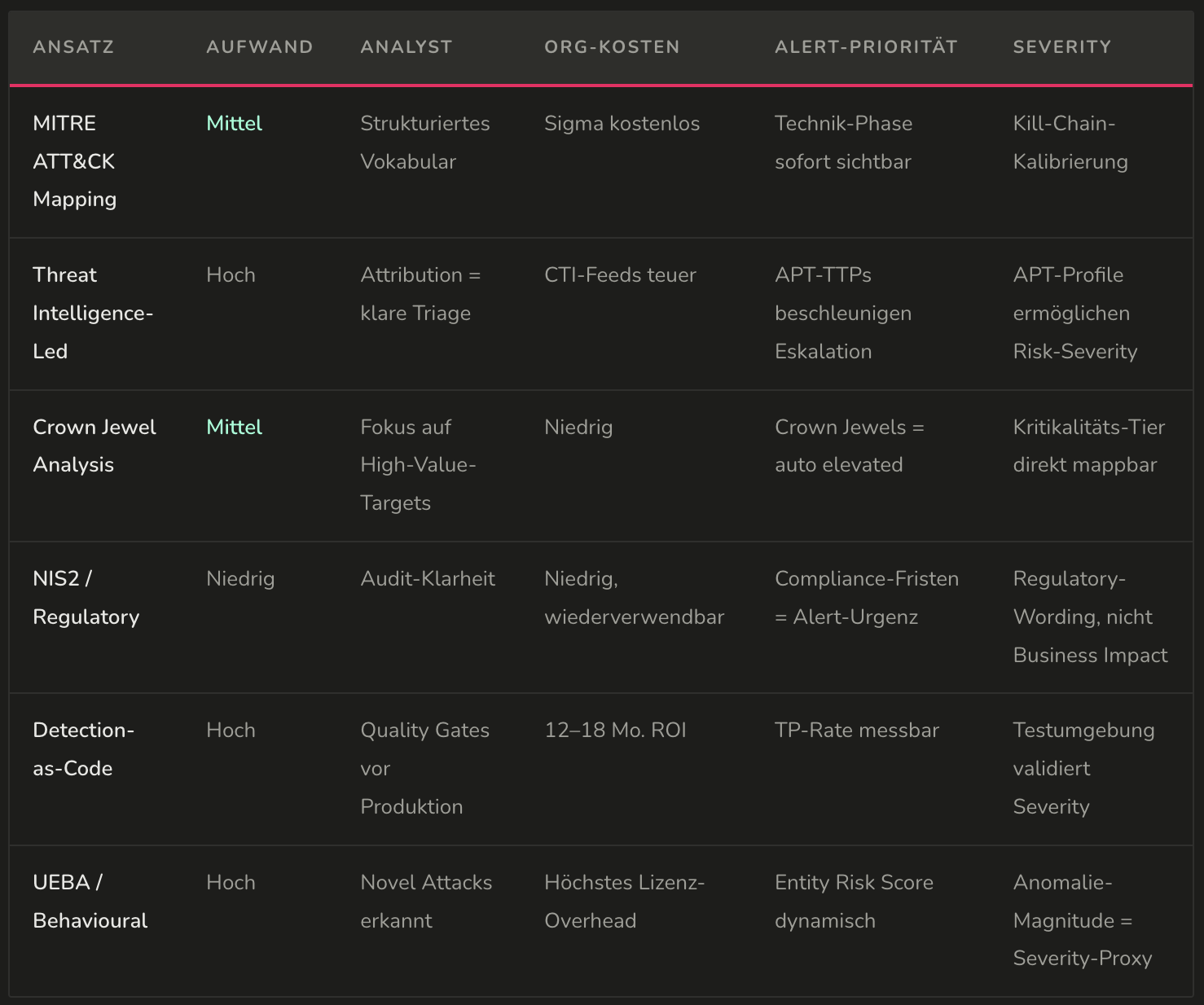
Comparison: All Approaches at a Glance
The following table compares all approaches along the five evaluation dimensions:
The Best Strategy: A Layered Approach
No single approach is sufficient on its own. Each of the four categories compensates for weaknesses of the others: threat-driven approaches provide relevance, risk-driven approaches provide business alignment, compliance-driven approaches provide auditability, and data-driven approaches provide continuous quality validation.
Critical note: ATT&CK without CTI produces broad but unfocused coverage. CTI without ATT&CK lacks the structural framework. Both must be used together from the start.
The Recommended Four-Layer Detection Architecture
Layer 1: Threat-Informed Foundation
MITRE ATT&CK + Threat Intelligence-Led + Log Source Coverage Matrix
Structure and relevance at the same time. ATT&CK provides the vocabulary; sector-specific threat intelligence filters for the customer’s real threat profile. Low cost, fast deployment.
Layer 2: Customer Context
Onboarding Workshop + Crown Jewel Analysis
Generic rules become dangerous without customer-specific context. Highest marginal return with the lowest tooling effort. The most consistently undervalued element in MSSP programs.
Layer 3: Governance
SLA Tiering + Continuous Review Cycles (quarterly)
Alert priority becomes operationally concrete and contractually enforceable. Prevents rule decay.
Layer 4: Advanced (for mature customers)
UEBA or Detection-as-Code
Highest ceiling, but only worthwhile when the foundation is solid. Selectively for enterprise customers.
Two Critically Undervalued Approaches
The onboarding workshop is consistently underestimated. At almost zero tooling cost it captures customer-centric context – legacy systems, past incidents, undocumented business risks – that no automated tool can provide.
Alert fatigue-driven prioritization provides the most honest signal of whether the monitoring program is working. A rule with a 2% TP rate that fires 500 times a day is not a detection – it is operational debt.
The One Approach to Avoid as a Primary Strategy
Regulatory compliance as the primary driver of use case definition is the most common mistake in managed security services. It creates the illusion of coverage and produces rules for auditors – not for attackers. Compliance should run as a parallel constraint, never as the engine.
Conclusion
Defining and prioritizing use cases is one of the most consequential decisions a SOC makes – and one of the least systematically governed. The four approaches analyzed are not mutually exclusive alternatives – they are complementary layers.
ATT&CK and community libraries provide the baseline. Customer workshops and crown jewel analysis provide business alignment. Sector-specific CTI provides relevance. Continuous review and alert fatigue analysis provide operational discipline. Detection-as-code and UEBA provide scalability and novel threat coverage for mature programs.
The organizations with the most effective monitoring programs are not those with the largest rule libraries. They are the ones that make deliberate, documented and continuously reviewed decisions about what they monitor – and why.
apt-one GmbH is a specialized managed detection and response provider focused on building high-fidelity, customer-centric security monitoring programs for organizations across Europe. We work closely with our customers – from the initial threat analysis to ongoing monitoring – and see security not as a product but as a continuous process.
Ready to take your security posture to the next level? Talk directly to our security experts – no obligation and as equals.
Related articles

Incident Response – Eradication
Eradication is the turning point of incident response. It’s where you move beyond containment to fully eliminate…

Open Source SIEM Solutions
Open-source SIEM solutions offer cost-effective, customizable, and flexible network security monitoring. However,…

Awareness Campaign
Cybersecurity starts with people. Find out why an awareness campaign is crucial for closing knowledge gaps…